
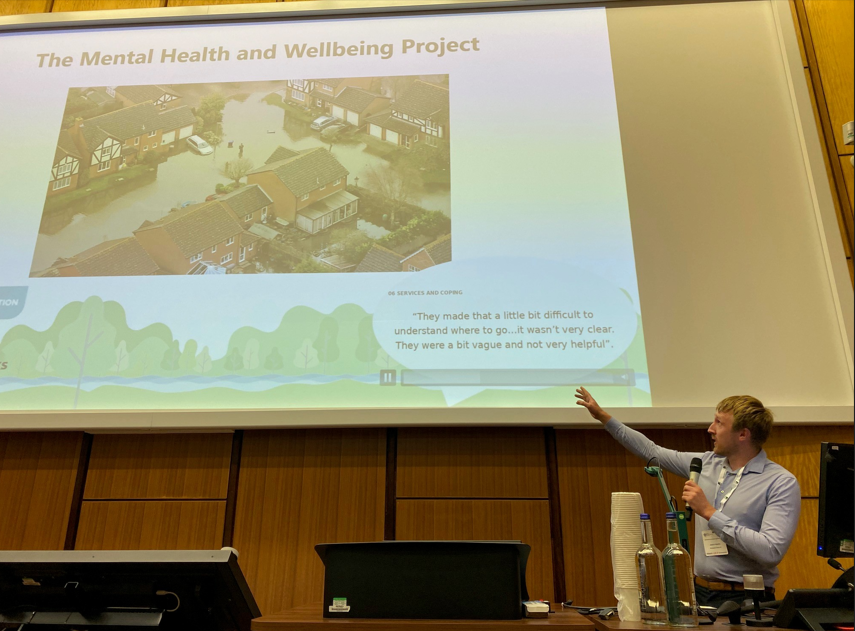
Pictured: Jason Hanks, flood manager at Kirklees Council, presenting about the WYFLIP project at the British Hydrological Society’s Symposium. It was voted the best presentation by delegates at the national event.
A final report with findings and recommendations has been produced by Dr Dillon Newton and Dr Tom Simcock, University of Huddersfield – The Mental Health Impacts of Flooding in Yorkshire: Evidence, System Gaps and Responses – following a study conducted as part of a West Yorkshire Flood Innovation Programme (WYFLIP) project.
A major challenge facing all local authorities is making sure communities have access to mental health and resilience support following disasters, such as flooding, and raising awareness of the risks so that households can be as prepared as possible.
The Mental Health and Wellbeing for Flood Risk Communities WYFLIP project, led by Kirklees Council, with support from the Environment Agency, examines what impact flooding can have on the mental health of at risk communities.
The aim of the project is to understand how individuals and communities experience and manage the impact of flooding and where current systems succeed or fail in providing suport. It looks at their coping mechanisms and barriers they face getting the support they need. Its findings will provide evidence needed to develop new innovative and effective approaches to help mitigate risks of flooding and improve flood resilience for communities.
The first stage of the project was conducted by Kirklees council who worked with a local mental health charity to train 100 frontline staff to improve their awareness and ability to support people at risk of flooding with mental health problems.
They then partnered with researchers from the Healthy Housing Initiative, University of Huddersfield who provided extra funding from Creating Opportunities through Local Innovation Fellowships (COLIF).
The researchers conducted:-
- A large-scale online survey of around 438 people amongst communities who are at risk of flooding in the region
- In-depth interviews with households who had experienced internal flooding
- Workshops for community groups to help come up with new solutions and design useful resources, such as a toolkit that would help people prepare for flood events.
Evidence was gathered during the study to inform how mental health services could be delivered by Kirklees Council for people affected by flooding. The plan is to share learnings from this project to benefit others further afield throughout the region – and then nationally.
By painting a picture of what is happening to residents we serve we can begin to help them, said Jason Hanks, project lead and flood risk manager at Kirklees Council.
Respondents told us….
- “I wasn’t sleeping properly for weeks. Every noise, every bit of rain. I’d wake up and it left me unable to focus on anything.”
- “Now every time it rains heavily, I feel that same anxiety again – it just comes straight back.”
- “You watch the forecast constantly. If there’s a warning, you’re already preparing for the worst.”
- “We lost so much and you never really get it all back even with insurance.”
- “It was (spouse’s name) and the community that helped me get through it.”
- “Local businesses were fantastic and the community spirit was wonderful. That was a great help.”
- “People were coming around with meals, the shops were giving away all their goods, there were food parcels and all kinds of stuff.”
- Amongst all this horror, there was such camaraderie and kindness, everyone was just marvellous.”
Some key findings from the report are:-
- Mental health impacts are common amonst people affected by flooding and can persist after the practical recovery from flood events
- Flooding was rated as causing the second most psychological distress in life – the top is death of a spouse and it is on a par with divorce
- People whose homes or lives are affected by flooding are six times more likely to develop depression, anxiety or PTSD
- Impacts on their mental health were still prevalent three years after the event
- Existing support systems do not consistently reach people experiencing distress contributing to substantial unmet need
- Communities often rely on informal networks and local relationships and could respond to community-based approaches alongside formal services
- People do pull together in a crisis.
Here’s a thematic summary of our findings
- Anxiety and trauma-related distress can persist after flooding and be triggered by rainfall and reminders of previous events. Heavy rain alone was enough to trigger heightened tension. “Even the window cleaner sets me off, it’s the water straight on the window that is triggering for me.”
- Long term loss disruption and financial strain deepen emotional distress. The emotional impact is compounded by repeated property damage, slow recovery and lack of financial capacity to rebuild. The cycle of loss and repair creates exhaustion and a sense of being word downover time: “Trying to juggle a full-time job, insurance, builders, gas, electric, water – there was just too much to do for one person to do it on their own.”
- For some people, preparedness becomes an exhausting personal burden. Participants described taking extensive steps to protect their homes. It becomes a form of hypervgilience that’s emotionally and financially draining. “I’ve done everything I can to stop my house being ripped out again… underfloor heating, a coal fire. I’ve had to do it myselfand it’s exhausting.”
- Weak or mismatched services and perceived poor infrastructure add to stress. Mental health support often feels ill-suited to the realities of flooding, while perceived local underinvestment ininsfrastructure amplify risk and frustration: “They (psychotherapist) wanted to desensitise me to water…but water isn’t the problem, the flooding is. Why build these big flood defences if there’s no money to maintain them.“
- Community support is a key emotional buffer. Informal caresuch as quiet check-ins, shared stories and neighours helping neigbours provides comfort and support. People rely on each other to make sense of the experience and feel less overwhelmed. However, support was not always straightforwardly helpful with some participants describing uncoordinated or unwanted assistance as an additional source of pressure. “It was my neighbour who put their arm around me and said this is perfectly normal reaction, that was helpful for me.”
The plan is to use findings from our research to develop a policy briefing with recommendations for policy makers, local authorities and housing organisations, both locally and regionally. Also to provide evidence to successfully bid for funds to develop initiatives or resources to improve wellbeing and preparedness amongst communities. Dr Dillon Newton, Univeristy of Huddersfield.
Plans for the future include:-
- Producing a detailed report on the findings
- Publish an article in a scientific journal
- Develop future funding bids to deliver interventions to improve resilience
- Develop a toolkit based on the implementation of the findings to support the delivery of mental health support before, during and after flooding
- Carry out longer-term research including taking the work to a regional or national level with comparisons from differing flood events including coastal.
Find out more information about the project.