

Pictured: Big Felt and Bog Pool, from Tenderbog by Laura Harrington and Feral Practice (Image Credit: Juri Vlassov)
Two UK artists Laura Harrington and Feral Practice (Fiona MacDonald), who work together as part of the WaterLANDS artists in residence, took part in an exhibition ‘Unbounded within – Symbiotic Subjectivities’, in Pärnu, Estonia.
The exhibition, which was timed to coincide with the WaterLANDS General Assembly, also featured the five WaterLANDS artists in residence from across Europe, plus five other artists from Norway and Estonia.
The exhibition – curated by Elo Liiv, who is the Estonian WaterLANDS artist in residence – explored the fading boundaries between humans and the environment in the Anthropocene, as ecological crisis and technological development force us to rethink our place in the world. It was about a journey from ‘I’ to ‘we’, where ‘we’ encompasses not only other humans, but also plants, bacteria, the fungal kingdom, the atmosphere, and mineral flows.
The WaterLANDS artists’ work touched on key interconnected topics related to wetlands and restoration, including extraction and its legacies, care as a practice in the context of restoration, representation and memory, and participatory actions to reveal environmental change, amongst others.
Tenderbog
During a four-year residency and exploration of peatlands in the Great North Bog, Laura and Feral Practice’s research and work together, is titled Tenderbog. It explores parallels between peatland restoration and human medicine, nurturing empathy with remote and fragile lands through considering shared micro and macro contexts, materials, techniques and problems in these seemingly disparate contexts.
They ran a workshop at University of Leeds about wound healing across human healthcare and peatland restoration. They invited nurses, researchers in wound care, people with lived experience of chronic and traumatic wounds, peatland conservationists and hydrologists to share their expertise and ideas across disciplinary boundaries. The workshop explored some strikingly similar issues in these very different contexts: around flows (of water, lymph, blood) that get out of balance – too much or too little, blockage or flood; around how an over-concentration on surface dressings can mask the real issues; and how health of bodies and bogs are similarly entangled with other flows – of money, profit and power.
Whilst in discussion they creatively engaged with materials used in peatland restoration and wound care, making sculptures that responded to ideas around flow and constriction.
These conversations, and many previous ones, informed one of the large sound sculptures that was transported to Estonia for the exhibition.
Exhibits for Estonia exhibition
The two large sculptures, Big Felt and Bog Pool, were made using protective materials and practices inspired by humans and other species, such as caddisfly larvae, who make their shielding cases from materials they find locally bound together with silk from their bodies.
“One is made of spruce bark plates embedded in latex. Our actions: of gathering and glueing to form a protective ‘armour’, were inspired by the caddisfly larvae we have loved meeting in bog pools. Spruce was especially appropriate as plantations of Sitka or Norway spruce have been the fate of many of northern England’s bogs. Forestry is just one of many ways people have tried to make bogs ‘pay’, instead of letting them be the powerhouses of biodiversity and carbon capture they are naturally.” Feral Practice
“The other is made of wool, felted by many hands, and feet, from the Swaledale and Shetland sheep who are also deeply intertwined with the fate of upland peat bogs. Many bogs were drained to make sheep pasture. Now peatland restoration workers are working with farmers trying to find new ways to make a living from sheep that can help, not harm, the bogs.” Laura Harrington
Each sculpture hung from the ceiling in a circle, a ‘Tenderbog embrace’ which visitors could enter to listen to the sound, which mingled voices that drew together material from the artists’ interdisciplinary research with specialists. Big Felt’s sound piece focused on the healing of chronic wounds in peat and human bodies, Bog Pool’s on the biodiversity of peat pools and the human gut microbiome, and how the catastrophic results of broad-spectrum antibiotics relate to the drainage of the bog. Alongside the sculptures the artists made a wall drawing inspired by the geotextiles and coir logs that abound in upland peatland restoration.
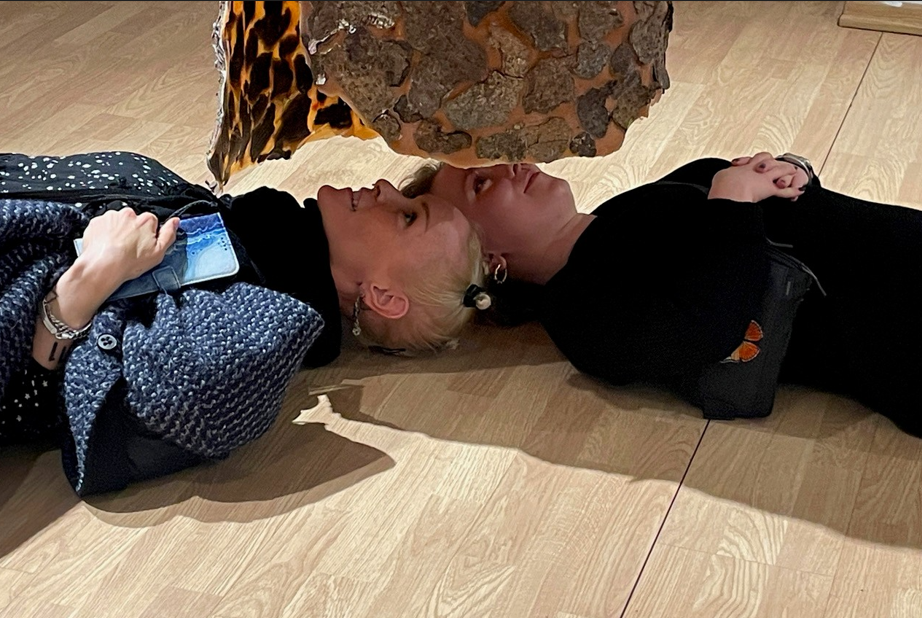
Pictured: Visitors experiencing the unique exhibition
“All bodies suffer, get damaged and wounds can arrive from outside or inside. Peatlands have suffered hugely at the hands of humans over centuries. The two sound sculptures bring together our dialogical research into specific parallels between human health care and peatland restoration. Bodies that can be wounded. Portals into biodiversity. Wrapping, mending, looking closely. Flows. Empathy.” Feral Practice
“One of the highlights of this ambitious EU wide project has been the generous and creative interaction we’ve had with the other WaterLANDS artists, so it was a total treat to see their works in real life and work together to make this show, which includes Estonian artists alongside all the Waterlands team.” Laura Harrington
“It was really special for me to see Fiona and Laura’s work exhibited in Estonia. No matter the ‘abstract’ nature of their work, it was very evident, even patent I would say, to me how it reflects the conversations and the joint experience that we had all gone through as a team and that have led to their art.
“I could feel ‘them’ (Fiona, Laura, the rest of the team) and ‘me’ interwoven in these pieces as related entities that meet one and other through the ‘fabric’ that peatlands represent to us all.
“To me this is this the very sense of what these art pieces bring to WATERLANDS, they are the reflect of our material and inmaterial relationship, amongst ourselves and with peatlands. I loved experiencing this art.” Professor Julia Martin-Ortega, Associate Director of water@leeds at University of Leeds, and a member of the WaterLANDS UK team
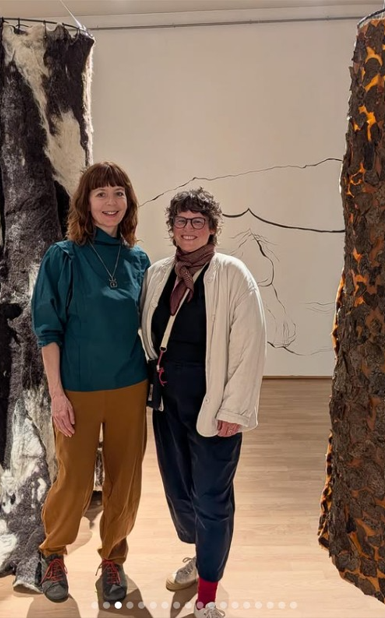
Pictured: Laura (left) and Fiona with their sculpture