
📅 Tuesday 29 September
⏲️10am – 12 noon
Online: Teams
Overview
The Blue Green Infrastructure training programme is a West Yorkshire Flood Innovation Programme (FLIP) project that addresses an urgent need for stronger skills in flood risk management and climate resilience across Yorkshire.
There is a critical gap in capacity and skills, which is a risk to the delivery of flood reduction and resilience benefits in the region. The work is funded by the Yorkshire Regional Flood and Coastal Committee (YRFCC) and will deliver a pilot training programme administered by iCasp and water@leeds at the University of Leeds. For more information on the work of the West Yorkshire Flood Innovation Programme, please click here.
In England, 83% of the population now lives in urban areas where development has often been prioritised over nature. Development usually results in the sealing of the ground surface with impervious materials. With more extreme weather such as intense rainfall, the sealing inevitably leads to surface flooding and a range of other environmental problems such as the urban heat island.
Much research over the years has shown the multiple ecological and environmental benefits of urban green space and there have been growing efforts over recent years to reduce urban sealing. Legislation such as the Biodiversity Net Gain through the Environment Act 2021 is one such significant planning initiative.
Event Description
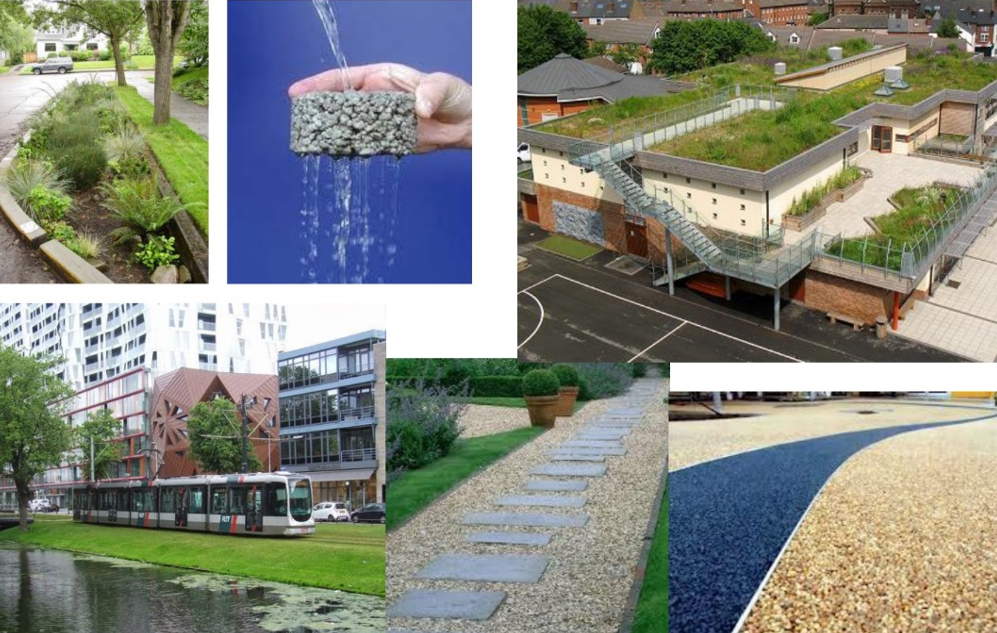
This session will be about urban green space and a protocol for reducing urban sealing. The protocol has been applied to several case study areas in Leeds to demonstrate its implementation.
It will be delivered by Dr Rizwan Nawaz, a Lecturer in Environmental Planning, Regulation and Industry at University of Leeds. He is a Chartered Environmentalist and Chartered Water and Environmental Manager, with expertise in sustainable urban drainage systems (SuDS), urban planning, green infrastructure, flood resilience, water management, and environmental policy. His research and teaching focus on the interactions between urban development, environmental sustainability, and climate resilience. Dr Nawaz has a particular interest in reducing urban surface sealing and promoting nature-based solutions that deliver multiple environmental benefits, including flood mitigation, biodiversity enhancement, urban cooling, and improved water management. At the University of Leeds, he contributes to research and teaching on sustainable development, environmental regulation, and urban environmental planning.
Research has shown the multiple ecological and environmental benefits of urban green space and there have been growing efforts over recent years to reduce urban sealing. More information will be posted on this webpage when it is available. If you have any queries email Sam Ramsden, iCASP Impact Translation Fellow.
Learning Outcomes
- An introduction to Sustainable Urban Drainage Systems (SuDS)
- To gain knowledge of some research on urban green space and its benefits
- To understand a protocol for reducing urban sealing and discover several case study areas in Leeds to demonstrate its implementation
- Become aware of relevant legislation.
Who can attend
Given the focus is surface flooding in urban areas, this work should be of interest/relevance to teams who work in planning, environmental and blue green infrastructure, Drainage Engineers and anyone who works with Sustainable Urban Drainage Systems.This includes teams from Lead Local Flood Authorities, the Environment Agency, Yorkshire Water and voluntary organisations. Due to the nature of our funding, attendees must be working in the Yorkshire region.
Please contact [email protected] for further information on place availability.